

2026 Arizona Legislative
Session End-of-Session Report
The Legislature adjourned sine die on June 13, 2026, after 153 days in session and an unprecedented volume of legislation. AMA advanced proactive housing policy while defeating, amending, or preventing more than 40 bills that threatened housing providers, development, and affordability across Arizona.
Session Stats
An unprecedented volume of legislation moved through the Capitol this year.
The Session at a Glance
Select a topic to view the full detail from the End-of-Session Report.
Convened Jan 12 · Governor's priorities
The 2026 Legislative Session convened on January 12, 2026, with Governor Katie Hobbs outlining her priorities focused on:
- Affordability
- Public Safety
- Housing
- Water Security
- Targeted Tax Relief
The Senate considered numerous gubernatorial appointments throughout the session, confirming leadership at several key state agencies, including:
- Debbie Johnston, Arizona Department of Health Services (ADHS)
- Ruby Dhillon-Williams, Arizona Department of Housing (ADOH)
- Alix Skelpsa Ridgway, Arizona Office of Tourism
- Charles Bassett, Department of Insurance and Financial Institutions (DIFI)
- Brig. Gen. John A. Conley, Department of Emergency and Military Affairs (DEMA)
Two legislative vacancies also occurred during the session. Cody Reim was appointed to represent Legislative District 3 following Representative Joseph Chaplik's resignation, and former Senator Sylvia Allen was appointed to fill the Legislative District 7 House seat after Representative David Marshall was named Navajo County Recorder.
$18.3B FY2027 · conformity fight
The most significant accomplishment of the 2026 legislative session was the adoption of Arizona's $18.3 billion Fiscal Year 2027 budget, ending months of negotiations over spending priorities. While early revenue projections had raised concerns about the state's fiscal outlook, improving economic conditions during the first half of the year provided lawmakers with additional flexibility during budget negotiations.
In January, Governor Hobbs proposed a $17.7 billion executive budget focused on affordability, housing, education, public safety, and government efficiency. Throughout the session, Republicans advanced several proposals to align Arizona's tax code with recent federal changes. Governor Hobbs vetoed early conformity measures, including the first majority budget package in May, citing long-term fiscal concerns and the lack of a broader bipartisan agreement.
See the Budget and Priorities sections below for the full detail on tax conformity, revenue offsets, and the data center moratorium.
Trust Fund, ADOH & what was left out
The FY2027 budget included:
- $3 million for nonprofit organizations providing statewide civil legal aid services
- $5 million for Area Agencies on Aging services that support vulnerable seniors and aging adults at risk of housing instability and homelessness
- Modifications to the Housing Trust Fund award process that prioritize projects leveraging federally funded housing programs
What was not included: statewide rental assistance programs, veterans homeless services funding, dedicated workforce housing programs, state Low Income Housing Tax Credit (LIHTC), and additional affordable housing development incentives.
The Senate's confirmation of Ruby Dhillon-Williams as ADOH Director was of particular interest to AMA given the agency's central role administering affordable housing programs, federal housing resources, homelessness assistance funding, and housing development initiatives statewide.
Defending the Rental Housing Industry
Throughout the session, AMA successfully advanced proactive housing policies while defeating, amending, or preventing the advancement of bills that would have negatively impacted housing providers, housing development, and housing affordability across Arizona.
One of AMA's most significant accomplishments this session was successfully preventing numerous harmful proposals from advancing through the legislative process — among the most significant defensive victories were defeating efforts related to rent control and rental price regulation and institutional ownership restrictions.
Priority Bills
Click a bill to view AMA's engagement and outcome.
Would have established liability for the Attorney General if a public nuisance or consumer fraud action is dismissed or found to lack merit.
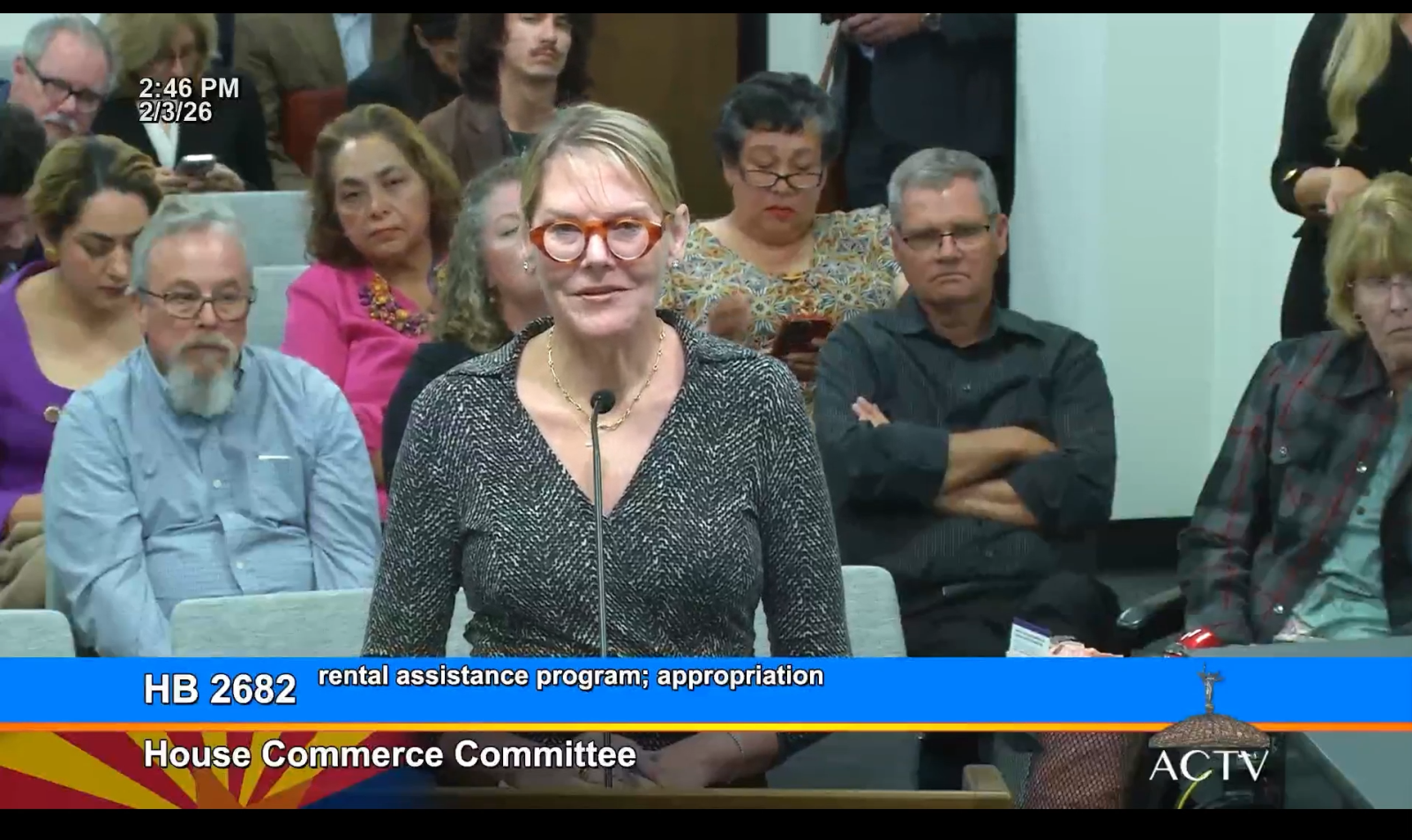
View bill text ↗Passed committee with bi-partisan support but ultimately failed to advance. HB2682 proposed a $5 million rental assistance program designed to assist renters experiencing temporary financial hardship.
View bill text ↗Passed committee with bi-partisan support but ultimately failed to advance. HB2698 established a study committee to evaluate Arizona's existing rental assistance programs and develop recommendations for future improvements.
View bill text ↗Passed the House but ultimately failed to advance. Would have created a state level Low-Income Housing Tax Credit program to incentivize affordable housing development in rural Arizona communities.
View bill text ↗Signed by the Governor. HB2946 makes several changes to how municipalities and counties calculate, assess, and collect development impact fees, with the goal of increasing transparency, predictability, and housing affordability.
View bill text ↗Signed by the Governor. HB2999 established a framework for creating housing affordability districts to finance infrastructure supporting residential development.
View bill text ↗Bills of Concern
Over the course of the session, AMA successfully helped defeat, amend, or stop more than 40 bills of concern to the rental housing industry. All bills below failed to advance unless otherwise noted.
New Risks for Landlords When Failing to Timely Satisfy Judgments
By Christopher Walker, C & W Law Group, P.C. — what changed, and how to protect yourself before the September 11, 2026 effective date.
Would have prohibited municipalities and counties in the Prescott Active Management Area from approving building permits for multifamily residential properties unless the applicant provides either a written commitment of water service from a designated provider with an assured water supply or a certificate of assured water supply issued by the Arizona Department of Water Resources.
Proposed expanding state anti-discrimination statutes relating to employment, housing, and public accommodations.
Proposed significant changes to rental application fee practices, including disclosure requirements, refund provisions, and substantial liability exposure for housing providers.
AMA engaged on HB2244 to ensure any reforms to eviction record procedures maintained appropriate judicial discretion while protecting property owners' ability to make informed leasing decisions. AMA amended the bill and changed position to neutral; signed by the Governor.
Sought to impose ownership restrictions on institutional investors and limit certain real estate acquisition practices.
Sought to expand the definition of residential rental property to include property that is rented to lodgers for periods of less than 30 days.
Budget by Policy Area
Select a category to view what was funded — and what was left out.
Water Security Investment
- $20 million transferred to the Water Supply Development Revolving Fund
- $9.5 million deposited into the Water Quality Fee Fund
- $6 million appropriated for Colorado River legal defense and litigation activities
- Expanded eligibility under the Cyber Ready Arizona Program to include local wastewater facilities, recognizing the growing importance of cybersecurity protections for critical infrastructure
These investments underscore the Legislature's recognition that water security remains essential to Arizona's economic growth and long-term sustainability.
Housing and Homelessness
- $3 million for nonprofit organizations providing statewide civil legal aid services
- $5 million for Area Agencies on Aging services that support vulnerable seniors and aging adults at risk of housing instability and homelessness
- Modifications to the Housing Trust Fund award process that prioritize projects leveraging federally funded housing programs
- Statewide rental assistance programs
- Veterans homeless services funding
- Dedicated workforce housing programs
- State Low Income Housing Tax Credit (LIHTC)
- Additional affordable housing development incentives
Infrastructure, Transportation, and Economic Development
- The Public Infrastructure Improvement Program increases its funding cap by $50 million annually for three years and expands eligibility to include municipal wastewater projects
- $183 million in one-time funding for the School Facilities Division Building Renewal Grant Program, while maintaining the $16 million baseline appropriation
- $2.5 million annually from Highway User Revenue Fund revenues into the State Match Advantage for Rural Transportation (SMART) Fund to assist rural communities in securing federal matching dollars
- Proposition 123
- The anticipated $760 million federal reimbursement for border-related expenditures
- Additional sports betting feed
- Tax on short-term rentals for education
Health and Human Services
- Full funding for the Department of Economic Security's Division of Developmental Disabilities (DDD), including supplemental appropriations necessary to address formula shortfalls carried over from prior fiscal years
- $4.3 million for critical access hospitals affected by federal funding reductions
- Continued one-time funding to reduce or eliminate school meal copayments for students in households earning between 131% and 185% of the Federal Poverty Level
Public Safety
- Border security fund
- Victim assistance program funding
- Law enforcement technology investments
- Exempts across-the-board agency reductions for public safety operations
- Converts the one-time 4% correctional officer stipend into a permanent 4% annual salary increase
Tax Conformity
Arizona's conformity with federal tax changes enacted through H.R. 1.
Legislative Republicans Argued
- Conformity simplifies tax filing.
- Maintaining alignment avoids taxpayer confusion.
- Businesses benefit from consistency between federal and state tax codes.
Governor Hobbs Argued
- Certain conformity provisions would create long-term revenue losses.
- Additional budget negotiations were necessary before adopting broad conformity measures.
Individual Tax Changes
- Aligns Arizona's standard deduction framework with federal law
- Creates a new $6,000 state income tax deduction for taxpayers age 65 and older
- Allows deductions for qualified tips of up to $25,000
- Allows deductions for qualified overtime compensation of up to $12,500 for single filers and $25,000 for married couples filing jointly
- Taxpayers who do not itemize deductions may deduct charitable contributions of up to $1,000 for single filers and $2,000 for married couples filing jointly, while itemized charitable deductions are subject to a 0.5% floor
Business Tax Changes
- Permitting full expensing for domestic research and development expenditures
- Adopting federal business interest deduction calculations
- Increasing the small business immediate expense threshold to $2.5 million
- Expansion of the State and Local Tax (SALT) deduction from $10,000 to $40,000
- The federal 100% special depreciation allowance for certain non-residential production property beginning in Tax Year 2026
Budget Revenue Offsets
To offset revenue reductions associated with conformity, lawmakers adopted several revenue-generating measures.
- 3-year moratorium on new Arizona Commerce Authority certifications for the state's data center equipment tax exemption
- Reduction of several corporate tax credits, including credits associated with business hiring, pollution control equipment purchases, and the refundable portion of the Research and Development tax credit
Lawmakers additionally preserved several economic development initiatives that had been proposed for reduction in earlier budget plans, including the $19 million Transaction Privilege Tax distribution for the Rio Nuevo District, and continued funding for the Arizona Commerce Authority's Compete Fund.
Under new requirements adopted with the FY27 budget, after operating expenses and debt service obligations are met, 80% of Rio Nuevo's state sales tax diversion revenues must be reinvested into projects that generate additional Transaction Privilege Tax revenues.
Data Centers Take Center Stage
One of the fastest-growing policy debates involved Arizona's booming data center industry. The budget imposes a three-year moratorium on new Arizona Commerce Authority certifications for the state's data center equipment tax exemption.
What Stayed Intact: Existing agreements remain protected. Previously approved projects retain their incentives.
Why It Matters: This compromise allows Arizona to reassess the long-term costs and benefits of data center incentives while preserving commitments already made to industry investors.
The moratorium is projected to generate:
- $12 million in FY2027
- $19 million in FY2028
- $26 million in FY2029
Agency Governance and Spending Reductions
To maintain long-term fiscal stability and absorb the fiscal impacts associated with tax conformity, lawmakers adopted a 2.5% across-the-board reduction in state agency operating budgets, scaled back from earlier proposals that contemplated 5% reductions.
Key exemptions were maintained for:
- Public safety operations
- Health and welfare services
- Certain constitutionally required programs
The budget also continues the Civil Rights Division within the Attorney General's Office, but eliminates the Civil Rights Advisory Board.
Ballot Measures
The Legislature referred seven measures to the November 2026 ballot during the final hours of the session, bringing the total number of legislative referrals before voters to ten.
Election Administration & Voter ID
School Athletics & Biological Sex
Municipal Photo Enforcement Renewal
Classroom Spending Requirements
Discrimination & Preferential Treatment
ESA Protections for Military Families
Public Resources & Labor Organizations
2027 Outlook
What AMA is watching heading into the interim and next session.
SB1608 Returns
AMA opposed SB1608's proposed indoor temperature and eviction moratorium standards this year. The sponsor has made clear this remains a priority she intends to bring back next session, and the Attorney General has also expressed interest in reviving the proposal. AMA will continue to engage early.
ADOH Leadership Ahead
With Ruby Dhillon-Williams confirmed as ADOH Director, the Department's leadership will continue to play an important role in shaping housing policy discussions during the interim and into the 2027 legislative session.
Data Center Moratorium Review
The three-year Commerce Authority certification moratorium is projected to generate $12M (FY2027), $19M (FY2028), and $26M (FY2029) — a fiscal reassessment AMA will monitor as it interacts with broader tax conformity conversations.